
Sunday, February 25, 2007

solution to brain teaser #3, answering riddle brain teasers

Solution to brain teaser #3

Rebbecca Dart: maple tree, backyard, Friday
Sally Frost: ash tree, patio, Monday
Tracy Grand: cherry tree, garden, Wednesday
Wanda Best: spruce tree, front yard, Thursday

How do I answer mind teasers in the form of riddles?

Riddles make you thing laterally and logically. Riddles will commonly rhyme, but it’s not a requirement. Most riddle will pose you a question in a vague and uncommon way. There is no one way to solve riddles. In fact, the only way to learn is to practise.

For example, the riddle: Where will you find roads without cars, forests without trees and cities without houses?

Forces your brain to ponder what it is. It’s vague and an uncommon way to pose the question

In fact, the answer is: a map.

There is simply no way to teach this. It is a matter of perception and practise. To help you practise, here is this week’s brain teaser.

Brain teaser #4

1-2-3-4-5-6

I am a 6 letter word.
Letters 6-5-2 spell out a drink.
Letters 4-5-2-3 spell out a fruit.
Letters 1-2-6 spell out a pet.
Letters 3-2-6 spell out a pest, which often gets eaten by 1-2-6.
What am I?

solution to brain teaser #3, answering riddle brain teasers

Solution to brain teaser #3

Rebbecca Dart: maple tree, backyard, Friday
Sally Frost: ash tree, patio, Monday
Tracy Grand: cherry tree, garden, Wednesday
Wanda Best: spruce tree, front yard, Thursday

How do I answer mind teasers in the form of riddles?

Riddles make you thing laterally and logically. Riddles will commonly rhyme, but it’s not a requirement. Most riddle will pose you a question in a vague and uncommon way. There is no one way to solve riddles. In fact, the only way to learn is to practise.

For example, the riddle: Where will you find roads without cars, forests without trees and cities without houses?

Forces your brain to ponder what it is. It’s vague and an uncommon way to pose the question

In fact, the answer is: a map.

There is simply no way to teach this. It is a matter of perception and practise. To help you practise, here is this week’s brain teaser.

Brain teaser #4

1-2-3-4-5-6

I am a 6 letter word.
Letters 6-5-2 spell out a drink.
Letters 4-5-2-3 spell out a fruit.
Letters 1-2-6 spell out a pet.
Letters 3-2-6 spell out a pest, which often gets eaten by 1-2-6.
What am I?

Sunday, February 18, 2007

Solution to brain teaser #2

31/81.

The total number of possibilities is 324 (6*6*9). The number of completely wrong guesses is 200 (5*5*8). So the number of partially or fully correct guesses is 124 (324-200). The probability is 124 out of 324, which can be reduced to 31 out of 81.

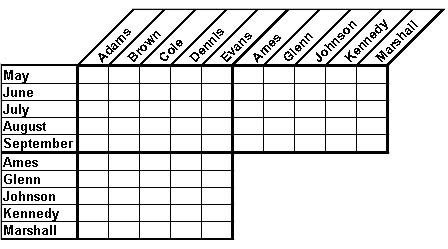
Example of logic grid:


How does a logic grid work in helping me solve brain teasers?

Some brain teasers give you a lot of information. In those instances, you may want to lay your information out neatly in the form of a logic grid. As the name suggests, it is a grid system you fill out based on logic. There is enough information given to you to be able to find the solution. You answer will usually take the form of: --

For starters, here is a relatively easy one for you to have a go. You can compare your answer to the solution posted next week:

Brian teaser #3

Four friends decided to plant a new tree in their yard to celebrate Labor Day. The new trees would each be put in a different area of their yards. As it happened each friend bought a different kind of tree and planted the new tree on a different day of the week. From the clues below, determine the full names of each friend, what kind of tree each bought, where in the yard it was planted, and on what day of the week each tree was planted.

Brain teaser #3
Names: Rebbecca, Sally, Tracy, and Wanda

Last Name: Best, Dart, Frost, and Grand

Trees: ash tree, cherry tree, maple tree, and spruce tree

Location: garden, patio, back yard, and front yard

Days of the Week: Monday, Wednesday, Thursday, and Friday

1. Wanda, whose last name wasn't Frost, didn't plant her spruce tree by the patio.

2. Tracy planted her tree before Mrs. Dart but after the woman who planted the ash tree.

3. Mrs. Best, whose first name wasn't Sally, planted her tree in the front yard, but not on Friday.

4. Rebbecca didn't plant her tree on Monday.

5. Mrs. Grand planted her tree before the woman who planted her tree in the back yard. Rebbecca didn't plant the cherry tree.

6. The trees were planted, in chronological order, as follows: Mrs. Frost, in the garden, Wanda, the maple tree.

Sunday, February 11, 2007

Answer to brain teaser #1, solving probability brain teasers

Answer to brain teaser #1

Red in the face

How do I tell if a mind teaser requires an answer that involves probability?

When you read the brain teaser, the first words on the last line will be ‘how likely’, ‘what are the odds’, ‘what is the probability’, etc.. These types of questions will tell you that probability is involved.

How do I answer brain teasers that involve probability?

That’s easy. You have probably done a little bit of probability sometime in high school. Solving brain teasers involving probability doesn’t get much simpler than this. However, you also need a bit of logic in order to solve the brain teaser – some are not as straightforward as it looks. The answers will make sense if you let you mind think laterally and logically.

Here’s this week’s mind teaser to keep you going.

Brain teaser #2

In Clue (called Cluedo in some countries, including its origin, England), you attempt to solve a murder mystery. There are six possible suspects, six possible weapons that the murderer could have used, and nine possible locations for the murder to have occurred.

If you guess a random suspect, a random weapon, and a random room, what is the probability of getting at least one right?

Sunday, February 4, 2007

answers to solving brain teasers, brain teaser #1

What are Brain Teasers?

Brain teasers are mental puzzles. They are designed to make you think laterally – a form of mental gymnastics. Logic is the key to solving brain teasers, but the answer or possible answers are usually not the first thing that you would think.

There are many categories of brain teasers. Some of these cannot be solved, as were not designed to be solved, or have no solution. A good example of this is optical illusions – they are designed to trick the mind only.

Why should I do brain teasers?

Brain teasers are a way of keeping an active mind. Older people may find enjoyment in solving brain teasers, as it can help them feel young and occupies otherwise free time. Alzheimer’s disease can also be slowed down or prevented by keeping an active mind and body. one way of doing this is to sit down and solve brain teasers.


How do I solve brain teasers?

The answer to some brain teasers is debatable, while some brain teasers have mnore than one ‘correct’ answer. There is not a singular way to find answers to mind teasers. Some requires logic-grids, some require lateral thinking, while others force you to think within constraints. These are multiple techniques to help you solve brain teasers, and you can use them to solve a variety of brain teasers. Eventually, you can think of some yourself

Here’s one to get you started:

faredce

Answer will come in a week’s time.